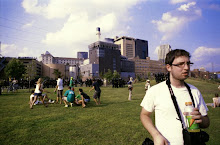
Today, I went to Shelter Studios to interview local photographer, Chris Sheehan. Besides having sweet digs (located at 2112 Broadway in Northeast), he also has a lot of insight and experience to share with photographers that are just starting out in the industry. After the interview, he gave me a tour of his studio, which is pretty sweet. If only we all could have our own coved walls and gigantic scrims. Overall, it was a really great experience and I think I was able to gain a greater understanding of what it takes to survive in this industry. Yay, photography!
I've also been shopping around for new camera insurance as I am not particularly satisfied with my current coverage and after the shenanigans they pulled in the last week, they aren't inspiring a whole lot of trust. The only thing that would make this situation worse is if they spontaneously decided to cancel my policy. Unfortunately, the array of insurance options available in the United States is less than inspiring. Maybe I'll move to the UK, just so I can be treated with respect when I file a claim. I'd even settle for a claim handler that actually does their job.
I couldn't find any of the other videos that I really wanted to show off, but don't let that diminish the important of this one. It's fairly basic, but I sure do love my psychology experiments. This video was made by filming the reactions of couples while listening to the song that is featured. It is, in large part, why I decided to attempt the Lovebirds series to begin with, which is a series that investigates what it means to be in a relationship.
Bright Eyes - First Day of My Life
Friday, April 17, 2009
Tuesday, April 14, 2009
"Keep The Car Running."
In the final manifesto made by the Refused when they broke up, they noted that it was more effective to spread the policy of "The Refused Party Program" if the band lived on as five solo projects instead of one project containing five members. Admittedly, I am not a five person band, but the common denominator is that I have been focusing on one project at a time when, really, I should be working on somewhere around five at a time. The problem, I've found, is that when I do one project at a time, each project gains a new, more evolved set of guidelines, which makes for a stark contrast in the treatment of the imagery. This is not mean I am looking for homogeny throughout my imagery. That is certainly not the case. What I am looking for is a way to let all of my ideas grow with me. If I continue this tedious work of doing one thing at a time, I'll have a lot of time on my hands. The simple fact of it is, I won't have the resources (not of the monetary variety) to continue one project all the time. What I will have, however, is enough resources to continue at least one of the five projects all the time. Hopefully, this will prove to be a good idea.
Also, while writing, or, more precisely, rewriting, this post, I was informed by the Hennepin County Sheriff that the cameras that were stolen from me nearly a year ago were recovered in a police raid last week. The insurance company claims that all items recovered from the raid, including items they refuse to pay out for, are theirs to keep. I was less than amused when the Sheriff told me this and told him to not hand anything off to the insurance company until I speak to the insurance adjusters involved face to face. I'm scheduled to meet with the Sheriff and the insurance company on Monday to put an end to this saga. Now all I have to do is reorganize the pile of papers, now more than an inch thick, to wage one last battle against the insurance company. Wish me luck.
Also, while writing, or, more precisely, rewriting, this post, I was informed by the Hennepin County Sheriff that the cameras that were stolen from me nearly a year ago were recovered in a police raid last week. The insurance company claims that all items recovered from the raid, including items they refuse to pay out for, are theirs to keep. I was less than amused when the Sheriff told me this and told him to not hand anything off to the insurance company until I speak to the insurance adjusters involved face to face. I'm scheduled to meet with the Sheriff and the insurance company on Monday to put an end to this saga. Now all I have to do is reorganize the pile of papers, now more than an inch thick, to wage one last battle against the insurance company. Wish me luck.
Monday, April 13, 2009
Turn Those Clapping Hands into Angry Balled Fists
In response to "Teaching Photography: Notes Assembled"
Is there a place for zoom lenses in photography, or are they a crutch?
I have a bias against zoom lenses, so it shouldn't come as any surprise that I believe prime lenses are more than adequate in any shooting situation. Zoom lenses are clunky, not particularly sharp, and they're slow. Slow, not only in terms of their maximum aperture, but also in the way that it takes longer for a person to frame up a shot. I have two perfectly functioning legs, which offer adequate zooming functions. As a result of only owning prime lenses, I have been able to act more instinctively with my cameras, which has allowed me to focus on other aspects photograph. Will prime lenses make you an award-winning photographer? No, not by a long shot. It will, however, give you one less thing to worry about. Simplicity is bliss, buy prime lenses.
In response to an interview of Stephen Shore by Tim Davis
Has the rise of print-on-demand services like Blurb diminished the value of the photo book?
Not long ago, it became very cheap to record a broadcast quality album within your own home. This allowed bands that were truly talented to produce and sell their own music. This has led to a very healthy underground music scene throughout the country and has given way to independent labels such as No Idea!, Plan-It-X, Afternoon Records, etc. Unfortunately, it also made it possible for talentless musicians to produce and sell a lot of bad music. The rise of print-on-demand services presents the same problems for photographers. On one hand, it allows talented photographers to make books without having to appeal to publishers like Aperture or Phaidon, which offers photographers a way to spread their creative seed across the land. On the other, it poisons the well with a lot of lackluster art. Which is more important?
Do you agree that photography is a problem-solving device?
We humans are skeptical of just about anything we can't see. Photography has, in many ways, made it possible to create a fairly undeniable way of recording visual information. Of course, we trust that everything depicted in the photographed is as it was when it was recorded and not altered in any way. As a result, anything we see in Time magazine, we interpret as truth, because we trust the photography, but more than that, the integrity of the magazine. So when we see photographs of atrocities thousands of miles away from us plastered across the front page, we have a hard time denying the existence of such things. Photographs also add a level of realism that words cannot properly convey. In this way, photographs are also more efficient. We can learn more in a second of staring at photograph than we can reading the whole article accompanying it. A single photograph can put people in a frenzy and before you know it, people are demanding something (the something is generally not specified or well thought out) be done. In a roundabout way, I do believe that photographs can be problem-solving devices as long as you have somebody competent at the helm.
Friday, April 10, 2009
I Don't Want Solidarity if it Means Holding Hands With You.
What part does honesty play in our photography? Not honesty in terms of representation, but honesty in terms of emotional reactions. How willing are you connect with your subjects? I can understand apprehension, because, after all, we have to be tough guys and gals and don't really like to "put ourselves out there", or are uncomfortable with the idea. Do we honestly expect to produce the same results as somebody who is really willing to empathize with their subjects? I know that a lot of the shoots that I thought were the most fun were the same shoots where I really got close to my subjects, both in proximity and emotionally.
I posted this video to go along with this text, because I have determined that songs by Tom Gabel are some of the most emotionally packed and passion-filled songs I have ever heard. They transcend the gap between simply singing the lyrics and putting yourself in the same emotional state as the lyrics while singing them. As a result, there is a sense of honesty and vulnerability that is transmitted through the music. As a photographer, I can appreciate this kind of honesty. It skirts the edge of being over the top emotionally and simply telling the truth. Then again, sometimes the truth is emotional.
Tom Gabel - Harsh Realms
Wednesday, April 8, 2009
"Give Me a Box of Your Finest Chardonnay."
This song and video, among others has been influential to the way I think about art, in general. The simplicity of it is nothing new. There have been plenty of bands that have consisted only of a drummer and a bassist. The interesting thing is the sound created when the two meet. The sound created by the bass is not as a result of pedals, synthesizers, or other circuit magic. The sound actually comes from the intentional misuse of the amplifier. In the same way, we, as photographers, cross-process film, shoot with expired Polaroids, make double exposures, etc. as part of our creative process. This is also as a result of the intentional misuse of our equipment. The relatively "avant-garde" nature of the creation of the music and the creation of our images can sometimes be off-putting, but the results are no less valuable, if only for the purposes of experimentation.
Death From Above 1979 - Romantic Rights
Death From Above 1979 - Romantic Rights
Sunday, March 1, 2009
To Lanterns, Denver, and One Last Lament
Assuming enough people enroll in the program, I will be in New Orleans, among other far off locales in the months of June and July. If fate takes its place, however, as it has in the last week, and especially in the last eight months, then I may have to sell souls on the side of the road to get to one or all of the desired destinations. Such a proposition is adventurous enough for me, though, and I will take on the task. I'm primed and ready for sleep deprivation, Arby's, and warmer temperatures.
Team Champagne for life.
Team Champagne for life.
Tuesday, February 17, 2009
Part Deux? Yes, please!
It's looking more and more like I'll be in New Orleans from June 22nd through the 30th with each passing day. This next time, pacing myself, being more deliberate, and editing long beforehand will be a top priority. One thing that won't change, however, is the exhaustive schedule. I still plan to be at every early morning shoot and make blog posts every night. Get ready.
Subscribe to:
Posts (Atom)

 Posts